Pages

Showing posts with label cell phone. Show all posts

Friday, June 28, 2013

BlackBerry fails to profit from BB10
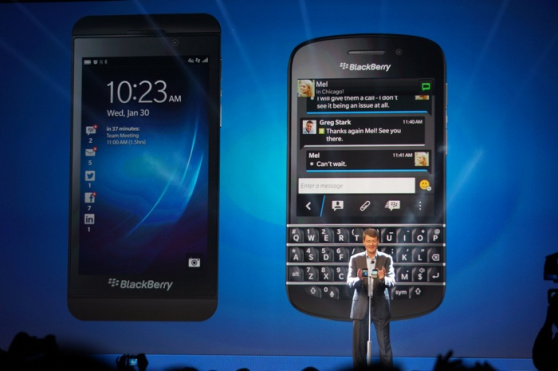
BlackBerry fails to profit from BB10


While it looked like BlackBerry was on the verge of a rebound last quarter, the company’s latest earnings results show that it’s still struggling to stay afloat.
BlackBerry announced this morning that it lost $84 million in the first quarter of 2013 on revenues of $3.1 billion (up 9 percent from last year). There was a glimmer of hope last quarter when it saw profits of $94 million, but whatever led to those gains didn’t help much this quarter.
This was a particularly important period for BlackBerry because it was the first time the Z10 BlackBerry 10 phone was available for the entire quarter (the keyboard-equipped Q10 was also available for part of the quarter). The company announced that it shipped 6.8 million smartphones during Q1, 2.7 million of which were BB10 devices, and 100,000 PlayBook tablets
During the company’s earnings call this morning, CEO Thorsten Heins reiterated that he was proud of BlackBerry’s ability to offer its own mobile platform. Heins didn’t offer up any specific reasons about BlackBerry’s setbacks this quarter — he just pointed out that it’s a long and difficult process to roll out a new platform — but he expressed some hope that the BlackBerry Enterprise Server (BES) 10 rollout should help the company stay afloat.
Unfortunately for PlayBook owners, Heins confirmed this morning that it won’t be seeing a BlackBerry 10 upgrade. He cited “performance and user experience concerns” for the move — not surprising, since the tablet’s hardware is several years old by now. The BlackBerry faithful often pointed to the company’s previously announced BB10 support for the PlayBook as one of the reasons it wasn’t like Apple or Google.
Looking ahead, BlackBerry says it will focus on rolling out new BB10 phones, BES10, as well as marketing its platforms throughout the year. The company will also invest in bringing BlackBerry Messenger to other mobile platforms this summer. BlackBerry also noted that it will continue to pursue cost-saving measures — so more layoffs seem imminent.
BlackBerry’s stock is down 28 percent at the time of this post.


Wednesday, June 26, 2013

Mobile key to the future of privacy and security — GSMA chairman


Mobile key to the future of privacy and security GSMA chairman

bernabe-mae-2013  
LIVE FROM GSMA MOBILE ASIA EXPO 2013: GSMA and Telecom Italia chairman Franco Bernabe (pictured) opened Mobile Asia Expo by outlining how “a laser focus on our customer’s privacy and security” will allow the mobile industry to make a key contribution to the future of innovation. With more people sharing and accessing data via mobile devices and the number of connected devices predicted to surge in the coming years, Bernabe said privacy and security concerns need to be addressed by the mobile industry.
“It is very important for our industry to consider this challenge, as most of this data will be uploaded using mobile networks,” he noted.
Citing e-commerce as an area of significant technological evolution, with NFC, mobile money and network APIs already being deployed, Bernabe said: “The underlying question of how to ensure privacy and security when developing e-commerce and m-commerce is crucial. In fact, these services are built on the internet that does not consider the principles of privacy in security, and is lacking an effective system for identity management.”
“In this context mobile technology, built around principles of privacy and security, could play a key role in responding to the needs of consumers,” he added.
Bernabe touted the security benefits provided by operators in the form of the SIM card, with its ability to be updated over the air. As such, the GSMA chairman said SIM is the “ideal location” to store confidential financial data for use in NFC services.
The GSMA expects to see one billion SIM-based NFC handsets sold by 2016.
In addition, Bernabe said the ‘ecosystem innovation’, seen with the OneAPI industry initiative, is “dramatically stronger” than the innovation coming from online service providers, as it encompasses standards and interoperability.
Bernabe concluded on a cautionary note by saying the future of innovation is dependent on the evolution of regulation and public policy: “Regulation can deliver a flourishing future where innovation and investment is encouraged, or can lead to a struggling ecosystem burdened by procedures and cost.”
http://www.mobileworldlive.com/mobile-key-to-the-future-of-privacy-and-security-gsma-chairman


Nokia Asha 501 smartphone makes colourful sales debut

Nokia Asha 501 smartphone makes colourful sales debut 


Espoo, Finland - Nokia announced that the Nokia Asha 501, the first of a new generation of smartphones to run on the new Asha Platform, will start selling this week in Thailand and Pakistan, with availability in India soon to follow. The new device will roll out in subsequent weeks across countries in Europe, the Middle East and Africa, Asia-Pacific and Latin America.
"The new Nokia Asha 501 helps people quickly access everything they love with just a simple swipe," said Timo Toikkanen, executive vice president, Mobile Phones, Nokia. "Coupled with beautiful design, it's a smartphone with both style and substance, offered at a great price."
The suggested retail price for the Nokia Asha 501 is 99 USD before taxes and local subsidies.
Standout colour and design
Nokia Asha 501 Color RangeThe Nokia Asha 501 is available in a choice of six striking colours: cyan, bright red, yellow, bright green, black and white*. Its seamless design comes in just two parts: a durable, removable shell and the scratch-resistant, tempered glass display. The compact, easy-to-use Nokia Asha 501 weighs only 98 grams, for the ultimate in portability. 
Fast, intuitive user interface
The Nokia Asha 501 works with just a simple swipe. Swipe unlocks the phone, closes apps and is used to shift between two screens: 'Home' and 'Fastlane'. Home makes full use of the three-inch capacitive touchscreen, displaying a traditional application launcher. Fastlane is the second screen that adapts to display recent activity on the phone as well as upcoming events, helping people multi-task. Fastlane also supports social integration with Facebook and Twitter, by allowing people to post directly from within Fastlane.
Instant access to apps and more
The new Asha comes with the Nokia Xpress Browser pre-loaded, which compresses Internet data by up to 90%, making mobile browsing faster and more affordable. People can enjoy a world of entertainment on the Nokia Asha 501, including pre-installed social apps like Facebook and Twitter; chat services like Line, Nimbuzz and WeChat; as well as up to 40 free EA games available to download, such as Plants vs. Zombies. Even more free apps and games are available from Nokia Store, including HERE Maps** and the new Nokia Xpress Now content discovery web app.
Device images are available at http://www.nokia.com/press.
* Colour selection will vary by market.
** As of July 1, 2013.
About Nokia
Nokia is a global leader in mobile communications whose products have become an integral part of the lives of people around the world. Every day, more than 1.3 billion people use their Nokia to capture and share experiences, access information, find their way or simply to speak to one another. Nokia's technological and design innovations have made its brand one of the most recognized in the world. For more information, visithttp://www.nokia.com/about-nokia.
- See more at: http://press.nokia.com/2013/06/24/nokia-asha-501-smartphone-makes-colourful-sales-debut/#sthash.NxjVtVdF.dpuf

Tuesday, June 25, 2013

Mobilink: computer lab facility to Kashmir Orphans Relief Trust


Mobilink Foundation provides computer lab facility to Kashmir Orphans Relief Trust

 Karachi - 25 June 2013:Mobilink Foundation has partnered with Kashmir Orphan Relief Trust (KORT) to set up a computer lab facility at the KORT managed orphanage in Mirpur, Azad Kashmir.
As a result of this partnership, KORT will be able to provide computer based education to resident children, as well as train its teachersin line with the latest technology curriculum. Mobilink Foundation has provideda total of ten computer systems as well as an integrated communications facility to enable online lessons.
Omar Manzur, Head of Corporate Communications, Mobilink highlighted, ‘’Mobilink Foundation is a strong advocate of the role of technology in enhancing the impact of literacy. We hope that our support in the form of the computer lab facility will help KORT make a positive impact on the academic learning of the children in their care.’’
Kashmir Orphans Relief Trust (K.O.R.T) was established after the devastating earthquake that devastated Pakistan and Azad Kashmir in 2005. The Trust currently accommodates close to 200 orphans at its custom made facility in Mirpur, Azad Kashmir. KORT is also building a new educational complex in Jarrikas, Azad Jammu &Kashmir, which will house 1,000 orphans with a total project cost of PKR 150 million.
The Mobilink Foundation is a reflection of the commitment of Mobilink and its employees to reshape lives of the community in which Mobilink operates. Established in 2007, the Mobilink Foundation is a non-profit organization, which provides support for the local community in the areas of health, education, environment and humanitarian assistance. Being a philanthropic organization, it is purely based on employee volunteerism that enables the Foundation to spend every penny directly towards the causes it is associated with. In 2013, Mobilink Foundation became Pakistan’s first and only telecom CR function to be certified by the Pakistan Center of Philanthropy (PCP).

Huawei Mobiles jump in “5G” race


Huawei became the latest vendor to join the “5G” war of words, stating that it is “at the cutting edge of technology exploration and development for 5G wireless” – despite the fact that as yet there is no official definition of what the term actually means. Last month, Samsung said it had developed 5G technology which it would look to commercialise by 2020. While Samsung’s recent release highlighted some of the specific technologies it is working with, Huawei’s was more marketing driven. It said it is “working on prototyping and have conducted field trials on cloud-based radio access networks”. Wen Tong, head of Huawei Communications Technologies Labs, said: “5G wireless will, first of all, open the frontiers of a new end-user experience. For example, visual communication will become the mainstream, and people will use wireless devices to interact instantly with people remotely, as if they were meeting face-to-face.” “5G wireless will also wirelessly connect an enormous number of “things” to the network. Therefore, in combination with cloud computing and Big Data technologies, we can essentially automate the entire society,” he continued. Huawei said that it is “actively participating in and driving broader industry ecosystem collaborations”, for example working with the METIS project co-funded by the European Commission. It said that at a recent METIS project meeting more than 140 researchers from industry, carriers and universities met to “crack the foundational technologies that will enable 5G wireless to come about”.

Sony Mobile goes big with phablet and smart watch


LIVE FROM GSMA MOBILE ASIA EXPO 2013: Sony Mobile has launched what it claims is “the world’s slimmest and largest full HD smartphone”, as well as its next generation smart watch. The Xperia Z Ultra (pictured) features a 6.4-inch display, making it the largest to date in the “phablet” category – and only slightly smaller than the 7-inch screens used by many tablets. Sony also said the Android 4.2 device is the first to feature Qualcomm’s Snapdragon 800 chip with 2.2GHz quad core CPU – which the vendor described as “the world’s fastest smartphone processor” – and 4G LTE support, and HD voice. It is waterproof and dust resistant and, echoing Samsung’s Galaxy Note line, also includes pen support – although without the need for a dedicated stylus. “We’re already bringing the best of Sony technology and design across a range of premium smartphones and tablets, and now we are bringing this same premium offering to the large-screen smartphone segment, setting a new standard for others to follow,” Calum MacDougall, director of Xperia Marketing at Sony Mobile, said. It will be available globally from the third quarter of 2013, with exact timing and availability varying by market. fc pic 1Against a backdrop of speculation about the smart watch plans of vendors including Samsung and Apple, Sony also unveiled its latest product in the category (pictured). Stefan Persson, head of companion products for the company, noted: “Competitors are only now launching first generation devices, while we are already launching a 3rd generation device with all the insight gained from over half a million customers combined with Sony’s wealth of technology expertise to create the best ever smart watch experience.” The company described the SmartWatch 2 as a “second screen for your Android smartphone”, serving as a “multi-functional watch, notifier, Android app interface and phone remote control all-in-one”. It also includes NFC for one-touch pairing with devices, and is water-resistant. According to Persson, there are more than 200 unique apps dedicated to the Sony SmartWatch line, with more than one million downloads to date. Smart Watch 2 will be available from September 2013. The company also used the event to debut two devices targeting the China market. It unveiled its first TD-LTE device for China Mobile, called Xperia SP M35t. It has a 4.6-inch HD display, an 8MP camera, and includes NFC support. And Xperia C S39h is Sony’s first exclusive device for China Unicom. It has a 5-inch screen, quadcore processor, and dual SIM support.

Monday, June 24, 2013

Nokia begins latest Asha sales


Nokia is this week beginning sales of its Asha 501 device, the first powered by the vendor’s new Asha Platform, which will be available at a sub-$100 price point. The new handset will be available initially in Thailand and Pakistan, with India “soon to follow”. It will subsequently rollout across Europe, the Middle East and Africa, Asia Pacific and Latin America. Nokia previously said it expects to sell 100 million of its “new generation Asha” devices in the future. The launch comes at a point when the company is facing fierce competition from a number of low-cost Android smartphone makers targeting emerging markets. Asha 501 has a 3-inch touch screen, includes Wi-Fi and Bluetooth, and will be available in both single and dual-SIM versions. It also has a 3.2 megapixel camera. The device lacks 3G support. It has two main screens: Home, which offers a traditional application launcher, and Fastlane, which “adapts to display recent activity on the phone as well as upcoming events”, and integrates with Facebook and Twitter. It also includes Nokia’s Xpress Browser, which compresses data by up to 90 per cent.

Deutsche Telekom sees M2M as route to global expansion


Deutsche Telekom views M2M not only as a means to generate new revenue streams but also as a way to break into new geographical markets and become a global player. In a recent video interview with Mobile World Live , Markus Breitbach, VP of global sales and marketing at Deutsche Telekom’s M2M Competence Center, said the German operator was looking to leverage its European M2M assets and expertise to expand its North American presence and then make more inroads into Asia. “M2M is already a huge multi-billion Euro business,” said Breitbach, pointing out the current strong demand from the European automotive sector. The health sector in the US, too, is showing keen interest. Breitabac emphasised, however, that M2M customers were not only looking to operators to provide cellular connectivity. Watch the interview to find out more, as well as hear Breitbach’s views on Deutsche Telekom’s M2M alliance with other European operators. by mobile world live

Telefonica inks Ireland sale deal

Telefonica confirmed a previously-rumoured deal which will see it selling its Irish business to 3 Ireland, in a transaction worth €850 million. The Spain-based group said that this is “part of Telefonica’s ongoing policy of proactive management of its asset portfolio with the aim of increasing the company’s financial flexibility”. Telefonica is in the process of a debt reduction effort which has seen it selling its Atento call centre business, floating part of its O2 Germany unit, and partnering with Central American investment fund Corporacion Multi Inversiones in this region. 3 Ireland, owned by Hong Kong-based conglomerate Hutchison Whampoa, will pay €780 million in cash on completion, and a further €70 million dependent on meeting certain financial goals. In a statement, 3 Ireland said that the acquisition of O2 Ireland will give it a market share of 37.5 per cent, with around 2 million active users. The acquirer also said that the deal will give it “scale and financial strength necessary to compete even more aggressively in the market to the benefit of consumers”, and leaves it “optimally positioned to become the number one player in the Irish market by providing the best value and service to its customers”. The deal is subject to conditions including securing regulatory approval. According to a report earlier this month, cable firm Liberty Global and incumbent Eircom had also eyed O2 Ireland.

Saturday, June 22, 2013

WhatsApp hits 250M active users

OTT messaging service WhatsApp has passed the 250 million active user mark, the company told the Wall Street Journal. This is the first time the company has revealed its user figures since it launched four years ago, although it revealed last week that it recently reached 27 billion messages processed in a single 24 hour period. The user figure is more impressive given its lack of marketing spend and puts the messaging app above Twitter’s 200 million monthly active users announced at the end of last year. However, Microsoft said in October that its Skype video-chat service has 280 million monthly active users. Despite the success of WhatsApp, it was reported earlier this week that Saudi Arabia’s national authorities have plans to block the service if it continues to fail to meet local regulations. The growth of free messaging apps that use Wi-Fi or mobile data to send messages is a concern for operators as they are impacting revenue traditionally generated by SMS messages and voice calls. Indeed, a report from Chetan Sharma Consulting this week said that WhatsApp has “moved around” more messages than all mobile operators combined in any country – including the US and China – during the last 12 months.