Pages

Showing posts with label Telecommunication. Show all posts

Tuesday, August 27, 2013

Samsung Makes Learning Fun


Karachi: August 27, 2013 – Samsung Electronics Co., Ltd, a leader in mobile technology and digital solutions, today announced the Samsung GALAXY Tab 3 Kids, a tablet built specifically for kids with the educational tools and safety features parents want.
 
“It’s no secret that kids are using technology more than ever before,” said JK Shin, CEO and Head of IT & Mobile Communication at Samsung Electronics. “We saw an opportunity to create a device just for kids that provides them with an intuitive, fun and kid-friendly user experience filled with rich, interactive and educational content that parents will love.”


Thursday, July 25, 2013

Oracle SPARC T5 and M5 servers arrived in Pakistan


Karachi: Oracle today announced availability of new Oracle SPARC T5 and M5 servers in Pakistan. The new T5 and M5 microprocessors are world’s fastest processor today with up to 3x faster application performance than IBM Power7 processor.  

Monday, July 8, 2013

Bharti Airtel Uses Qatari Money to Pay Down Debt

Bharti Airtel Uses Qatari Money to Pay Down Debt

Bharti Airtel has paid off just under 11% of its net debt with the proceeds from the recent sale of a 5% stake to the Qatar Royal Family.
Bharti Airtel said that it has retired debt of Rs 6,796 crore (US$1.26 billion) out of its total debt of Rs 63,800 crore (US$11.7 billion).
In stock market filing, the company said that this significant debt reduction will result in an improvement in the capital structure and balance sheet leverage for the company.
In June 2013, Bharti had issued new equity shares, representing 5% equity stake in the Company, to Qatar Foundation Endowment -- an investment company owned by the Qatari Royal Family -- for a total consideration of INR 6,796 crore.


Esri's global platform brings real-time traffic

Esri's global platform brings real-time traffic


Espoo, Finland - HERE, a Nokia business, today announced that it is bringing its real-time traffic information to Esri, a market leader in Geographic Information System (GIS) mapping software used by enterprise and government fleet management companies around the world.
With HERE Traffic, Esri will enhance its web and cloud location platform with more precise location data for intelligent routing. Fleet operators will be able to better manage problems as they occur in real time, re-routing fleets when traffic unexpectedly hits, and providing alerts when pickup or delivery delays occur.
With congestion in the top 100 highway bottlenecks getting worse, real time traffic information helps fleets avoid traffic hotspots so that they get can get to their destinations faster and more safely.*
"For 10 years, Esri and HERE have had the shared goal of enhancing safety and increasing the efficiency of fleet operations by offering the most accurate transportation information on more roads than any other provider across the world," said Chris Cappelli, Director of Sales at Esri. "Launching real-time traffic from HERE on Esri's platform for our ArcGIS Online and ArcGIS for Transportation Analytics software products will offer a deeper level of logistic and analytic capabilities for enterprise and government fleet companies."
Real-time traffic is one of the services that HERE delivers based on the data it gathers from a wealth of sources, including the world's largest compilation of both commercial and consumer probe data, the world's largest fixed proprietary sensor network, event-based data collected from government and commercial sources, and billions of historical traffic records.
"Dependable real-time traffic information is crucial to improving fleet operations strategy today and for the long-term," said Roy Kolstad, Vice President for Mobile, Web and Enterprise in North America at HERE. "Our traffic offering will complement HERE map content, which Esri has been using for a decade. Through this combination of traffic and map content, Esri will be able to provide a richer location-based analytics offering that will help businesses make more informed decisions."
The freshness of that data enables HERE Traffic to provide a more accurate picture of traffic conditions. HERE currently processes 20 billion real-time GPS probe points a month, with almost half of all the data less than 1 minute old and more than three-quarters less than 5 minutes old.
"Traffic data is the single most important telematics application," said Roger C. Lanctot, Associate Director in the Global Automotive Practice for Strategy Analytics. "Whether for fleets or consumers, traffic data is essential to determining the fastest or most efficient route and HERE's expanding relationships on the enterprise side are significant.  Traffic information is core to maximizing uptime and essential for alternative fuel vehicles such as EVs."
ArcGIS Online, http://www.arcgis.com, and ArcGIS for Transport Analytics, http://esri.com/arcgis4transport, are two GIS products supported by Esri's platform. The ease of accessing this powerful content will allow ArcGIS users to quickly embed traffic-aware routing into any application.
*U.S. Department of Transportation, Office of Public Affairs FHWA 2011:  http://www.fhwa.dot.gov/pressroom/fhwa1151.cfm
About HERE and Nokia
HERE, a Nokia business, is offering the first location cloud that delivers people the world's best maps and location experiences across more screens and operating systems unified under the HERE brand. To learn more about HERE, visit http://blog.here.com
Nokia is a global leader in mobile communications whose products have become an integral part of the lives of people around the world. Every day, more than 1.3 billion people use their Nokia to capture and share experiences, access information, find their way or simply to speak to one another. Nokia's technological and design innovations have made its brand one of the most recognized in the world. For more information, visit http://www.nokia.com/about-nokia.
About Esri
Since 1969, Esri has been giving customers around the world the power to think and plan geographically. The market leader in GIS technology, Esri software is used in more than 300,000 organizations worldwide including each of the 200 largest cities in the United States, most national governments, more than two-thirds of Fortune 500 companies, and more than 7,000 colleges and universities. Esri applications, running on more than one million desktops and thousands of Web and enterprise servers, provide the backbone for the world's mapping and spatial analysis. Esri is the only vendor that provides complete technical solutions for desktop, mobile, server, and Internet platforms. Visit us at esri.com/news.


Tuesday, July 2, 2013

Skype Passes 100M Android Installs and Launches Redesigned 4.0

Skype Passes 100M Android Installs and Launches Redesigned 4.0

Just recently, we reached a major milestone. Skype for Android is now installed on over 100 million phones worldwide. And we’re so thankful – reaching such an achievement would be impossible without the support of our users, and we continue to put you and your needs at the heart of everything we do.
Today we’re bringing 100 million of you a step further on our journey into the future. Last week we discussed how Skype’s Mobile Future demands a modern design that puts conversations first, focuses on quality & performance, and delivers a common set of experiences across multiple platforms and devices. Today, we’re excited to deliver in two of those areas with the all-new Skype for Android 4.0.
Android blog image

Modern design, putting conversations first.
We started to reimagine what Skype would look like back when we launched our Windows Phone 8 app late last year. Our focus was simple: we wanted to deliver an app that makes your interactions easier and puts conversations first. Our Android team saw this great work and wanted to deliver an equally bold, beautiful, and modern design in this latest Skype for Android release.
We’ve completely redesigned Skype for Android to be faster and easier – especially when you’re trying to fire off a quick message. Everything is at your fingertips. As soon as you open the app, you’ll notice the clean new look listing your recent conversations – just tap on one to catch up and reply. When you tap or swipe over to the Contacts or Favorites tabs, tapping on a person brings you right into a messaging window so you can start a conversation. And from there video calls, voice calls and everything else are just one tap away.
Increasing performance and quality.
Skype for Android 4.0 has all the features you use and love, but is a whole new app… literally. We didn’t just give Skype a makeover, we rebuilt it from the ground up to be faster and more reliable. We went beyond design and fundamentally changed the way Skype was built, focusing much of our effort on stability, performance, and load time.
This release is just the beginning. We have more updates in the coming months and year ahead to make Skype for Android even more reliable, reachable, and mobile-friendly. So keep watching, and we’ll keep you up to date as we roll out further improvements.
We’re always looking for ways to improve your experience and pay close attention to feedback provided by our community of users. To get the latest Skype news and tips about how to make your experience with Skype better than ever, follow us on Twitter and Facebook, or join us on the Skype Community.

Foxconn joins 4G race in Taiwan

Foxconn joins 4G race in Taiwan

Foxconn Technology Group, whose operations include the manufacture of Apple’s iPhones and iPads, has submitted an application to Taiwan’s National Communications Commission (NCC) to be a qualified bidder in the country’s upcoming auction of 4G spectrum.
Otherwise known as Hon Hai, a Taiwanese technology giant, the Foxconn Technology Group is looking to diversify beyond its traditional core businesses of PC and mobile device manufacturing.
Regulator NCC, according to various reports, confirmed Hon Hai among the bidders on 1 July, the deadline set for applicants. The technology firm is making its application through Ambit Microsystems, a Hon Hai business unit.
Foxconn’s entry into the 4G race takes the total number of applicants up to seven. The others, according to Digitimes, include Taiwan’s existing 3G operators – Asia Pacific Telecom, Chunghwa Telecom, Far EasTone Telecommunications and Taiwan Mobile – a mobile telecom company newly established by the Ting Hsin International Group, and a company newly set up by the Shinkong Group.
NCC says it will announce the list of qualified bidders by the end of August with the auction slated for early September.
Five licences are likely to be awarded, according to various reports, with a combined reserve price set at TWD35.9 billion ($1.2 billion) for all spectrum going under the hammer.
NCC will auction spectrum in the 700MHz, 900MHz and 1800MHz frequency bands.


Worldwide IT Spending on Pace to Reach $3.7 Trillion in 2013

Worldwide IT Spending on Pace to Reach $3.7 Trillion in 2013

Worldwide IT spending is projected to total $3.7 trillion in 2013, a 2 percent increase from 2012 spending of $3.6 trillion, according to the latest forecast by Gartner.
Last quarter, Gartner's forecast for 2013 IT spending growth in U.S. dollars was 4.1 percent. The 2.1 percentage point reduction mainly reflects the impact of recent fluctuations in U.S. dollar exchange rates; growth in constant currency is forecast at 3.5 percent for 2013, down only slightly from last quarter.
"Exchange rate movements, and a reduction in our 2013 forecast for devices, account for the bulk of the downward revision of the 2013 growth," said Richard Gordon, managing vice president at Gartner. "Regionally, 2013 constant-currency spending growth in most regions has been lowered. However, Western Europe's constant-currency growth has been inched up slightly as strategic IT initiatives in the region will continue despite a poor economic outlook."
The forecast for spending on devices in 2013 has been revised down from 7.9 percent growth in Gartner's previous forecast to 2.8 percent (see Table 1). The decline in PC sales, recorded in the first quarter of 2013, continued into the second quarter with little recovery expected during the second half of 2013. While new devices are set to hit the market in the second half of 2013, they will fail to compensate for the underlying weakness of the traditional PC market. The outlook for tablet revenue for 2013 is for growth of 2.8 percent, while mobile phone revenue is projected to increase 7.4 percent this year.

Worldwide IT Spending Forecast

(Billions of U.S. Dollars)
  2012 2013 2014
Spend Growth Spend Growth Spend Growth
Devices 676 10.9% 695 2.8% 740 6.5%
Data Center Systems 140 1.8% 143 2.1% 149 4.1%
Enterprise Software 285 4.7% 304 6.4% 324 6.6%
IT Services 906 2.0% 926 2.2% 968 4.6%
Telecom Services 1,641 -0.7% 1,655 0.9% 1,694 2.3%
Overall IT 3,648 2.5% 3,723 2.0% 3,875 4.1%
Source: Gartner (July 2013)
Enterprise software spending is on pace to grow 6.4 percent in 2013. Growth expectations for customer relationship management (CRM) have been raised to reflect expanded coverage into e-commerce, social and mobile. Expectations for digital content creation and operating systems have been reduced as software as a service (SaaS) and changing device demands impact traditional models and markets.
Telecom services spending is forecast to grow 0.9 percent in 2013. Fixed broadband is showing slightly higher than anticipated growth. The impact of voice substitution is mixed as it is moving faster in the consumer sector, but slightly slower in the enterprise market.


Vodafone Offers to pay more for renewal of licenses

Vodafone Offers $680 Million to Renew Indian Licenses

 Vodafone's Indian operations has offered to pay Rs40 billion (US$680 million) to settle a dispute over the renewal of its licenses in Delhi, Mumbai, and Kolkata.
The government refused to automatically renew the licenses when they expired, and wants to sell off the spectrum in an open auction. However, Vodafone argues that the licenses include a clause permitting automatic renewal, at an agreed price.
Citing a letter sent to the Department of Telecoms, the Wall Street Journal said that Vodafone made the unsolicited offer of US$680 million to try and settle the dispute.
Vodafone had cited clause 4.1 of the license that was granted to it in 1994 which allows for a 10-year extension on mutually agreed terms if the mobile network makes the request during the 19th year of its license.
Vodafone filed the application at the end of last year, and has since filed a lawsuit seeking enforcement of the license conditions.
On the web: Wall Street Journal

Apple Accued Tax Theft

Apple Avoiding Paying Tax on UK Profits in 2012

Apple has been accused of using share options for staff to offset taxes it would have otherwise had to pay in the UK on revenues of nearly £1 billion last year.
Citing company accounts, the Daily Telegraph noted that Apple Retail UK Ltd made a pre-tax profit of £16 million on sales of almost £1 billion in the twelve-months to the end of last September.
The company also made a pre-tax profit of £51.8 million from two other UK registered subsidiaries.
However, the company was then able to claim tax deductions worth £27.7 million for share awards granted to its employees. In fact, the company had a net tax loss, and was able to carry forward £3.8 million in tax credits against future profits.
Apple is also suspected of possibly having higher sales to UK consumers than is being reported as the sales are routed via lower tax jurisdictions. Apple routes an unspecified amount of its sales via Ireland, which has a lower tax rate than the UK.
Google is facing an investigation in the UK for a similar practice, while Amazon has been criticized for routing most of its UK sales via Luxembourg, leaving the UK as just a distribution centre.
On the web: Daily Telegraph


Monday, July 1, 2013

Nokia Siemens Networks Wins Saudi Network Expansion Contract

Nokia Siemens Networks Wins Saudi Network Expansion Contract

 Nokia Siemens Networks has won an 18-month network upgrade contract worth US$325 million from Saudi Arabia's Mobily (Etihad Etisalat).

Under terms of the agreement, Nokia Siemens Networks will facilitate a long term export credit with Finnvera, Finnish Export Credit (FEC), and lenders Credit Agricole and Deutsche Bank.
Mobily will use this credit to fund the purchases from Nokia Siemens Networks.
Khalid AI-Kaf, CEO, Mobily, said: "In our commitment to constantly enhance mobile broadband service experience for our customers, we will be investing 325 mn USD over the next 18 months to upgrade and expand our mobile broadband infrastructure. This infrastructure upgrade using Nokia Siemens Networks' advanced solutions and services will set a new benchmark in providing unmatched data service experience in Saudi Arabia."
Topi Vesteri, Executive Vice President of Finnvera, said: "This will be the largest transaction Finnvera and FEC is supporting in the Kingdom of Saudi Arabia, and in the Middle East. We look forward to contributing with our credit enhancement of highest credit quality to the success of Mobily and Nokia Siemens Networks in the growing Saudi Arabian telecom market."
Mobily was established in 2004 by a consortium led by UAE based Etisalat. It currently has a market share of around 40 percent.
Click on images to enlarge

Nokia Siemens Networks CEO Rajeev Suri, CFO Samih Elhage, and Mobily CFO Thamer Alhosani and CEO Khalid Al-kaf

Siemens Sells its 50% Stake in Nokia Siemens Networks

Siemens Sells its 50% Stake in Nokia Siemens Networks

Siemens has sold its 50 percent stake in Nokia Siemens Networks for EUR1.7 billion (US$2.2 billion) -- to its joint venture partner, Nokia.
Siemens has long been looking to sell, and it had been expected that the buyer would be a private equity investor after a partial floatation of the stake had been ruled out.
Nokia said plans to retain the existing management and governance structure at Nokia Siemens Networks, which is not surprising as it already had management control of the company.
Stephen Elop, President and CEO of Nokia, commented: "With its clear strategic focus and strong leadership team, Nokia Siemens Networks has structurally improved its operational and financial performance. Furthermore, Nokia Siemens Networks has established a clear leadership position in LTE, which provides an attractive growth opportunity."
The two companies set up the joint-venture in 2007, but it has struggled in recent years and underwent a substantial downsizing exercise last year. That effort has however turned the company around and it is expected to turn a profit within the year.
Nokia said that it will continue to consolidate Nokia Siemens Networks for financial reporting purposes as well as working towards pitching the company as an independent entity.
Nokia Siemens Networks' operational headquarters will remain in Espoo, Finland, and the company will continue to have a strong regional presence in Germany, including its major hub in Munich.
Nokia Siemens Networks restructuring plan remains unchanged as a result of the change in ownership.
Nokia also confirmed that the Siemens name will be phased out, and the new (hopefully less cumbersome) name will be announced once the deal secures regulatory approval.
The purchase price totals EUR 1.7 billion, of which EUR 1.2 billion will be paid in cash at the closing of the transaction. The balance of EUR 0.5 billion will be paid in the form of a secured loan from Siemens due one year from closing. Nokia has obtained committed bank financing for the EUR 1.2 billion cash portion.


Saturday, June 29, 2013

Mobile Roaming Within Europe Lower Price Caps from 1 July

New Lower Price Caps for Mobile Roaming Within Europe from 1 July


From 1 July 2013, the European Union's Roaming Regulation will lower the price caps for data downloads by just over a third (36%) while travelling across the EU.
Data roaming will now be up to 91% cheaper in 2013 compared to 2007. The EU has achieved retail price reductions across calls, SMS and data of over 80% since 2007.
Each year, Europeans make several million visits to Croatia, which joins the EU on 1 July. This year visitors to Croatia will enjoy spectacular savings as the cost for data decreases almost 15 fold and sending a SMS or making a phone call elsewhere in the EU will be 10 times cheaper.
Commission Vice President Neelie Kroes said: "The EU has to be relevant to people's lives. The latest price cuts put more money in your pocket for summer, and are a critical step towards getting rid of these premiums once and for all. This is good for both consumers and companies, because it takes fear out of the market, and it grows the market.
The new prices caps, which enter into force on 1st July 2013, are:
  • Downloading data or browsing the Internet - 45 cents / Megabyte (MB) (charged per Kilobyte used) + VAT. (36% reduction compared to 2012)
  • Making calls - 24 cents / minute + VAT (17% reduction compared to 2012)
  • Receiving a call - 7 cents / minute + VAT (12.5% reduction compared to 2012)
  • Sending a text message - 8 cents + VAT (11% reduction compared to 2012)
Operators are free to offer cheaper rates, and some have already begun to remove roaming premiums altogether for voice and SMS, or offer a roaming-free area region across one section of Europe or another.


Friday, June 28, 2013

UK authorities launch crime unit to tackle online piracy

UK authorities launch crime unit to tackle online piracy


Can’t wait to watch Brad Pitt face off against a Zombie pandemic? You’ll have to shell out for a movie ticket, as torrent sites may soon be a thing of the past.
The UK government is taking a heavy-handed approach to online piracy, and is launching a new Intellectual Property crime unit in September. The new unit will be targeting operators of torrent sites.
The news was announced in London this morning by Intellectual Property Minister Lord Younger and City of London Police Commissioner Adrian Leppard today. In a press conference, Leppard said this is first of its kind, and is “ensuring that the UK stays at the forefront of intellectual property enforcement.” He described online piracy operators as “organized crime gangs” who “illegally profiteer on the backs of others’ endeavors.”
Over 2.5 million in funding has been set aside by the UK’s Intellectual Property Office. It will be used by the City of London Police to establish and run the unit.
According to Leppard, the goal is to safeguard jobs for content-creators, but also ensure citizens’ “computer safety.” With fewer operators running these sites, Internet-goers will be less likely to be exposed to unauthorized copyrighted content.
In the UK, The Creative Coalition’s TERA Report (2010) found that if copyright infringement continues unabated, up to a quarter of a million jobs in the UK could be at risk by 2015.
In the U.S., the problem Economic consultancy firm Frontier Economics recently estimated that U.S. Internet users alone annually consume between $7 and $20 billion worth of digitally pirated recorded music. As a consequence of online piracy, the U.S. economy loses approximately $12.5 billion in total output annually, according to a 2007 study by the Institute for Policy Innovation. Check out this infographic on the true cost of piracy.
This isn’t the first major crackdown on Internet piracy. On Wednesday, U.S. authorities seized 177 domain names for websites selling counterfeit trademark merchandise. According to press reports, another 151 sites were shut down by the European Police (Europol) in coordination with authorities in Belgium, France, Romania and Britain.
Companies like Comcast have also taken steps to curtail online privacy. It will shut down your browser if it suspects that you’re illegally downloading content.
The new unit is set to launch in September, and will receive funding for a minimum of two years.


BlackBerry CEO confirms PlayBook tablet won’t be getting BB10

BlackBerry CEO confirms PlayBook tablet won’t be getting BB10


Sorry, BlackBerry PlayBook owners, there’s no BlackBerry 10 for you.
During the company’s first quarter earnings call today, chief executive Thorsten Heins confirmed that the PlayBook tablet won’t see a BB10 upgrade. Heins cited “performance and user experience concerns” for the move — which isn’t a huge surprise, since the PlayBook’s hardware is several years old.
BlackBerry announced a disappointing $84 million Q1 loss this morning, so the company certainly has more important things to focus on rather than supporting a tablet that few people have bought.
While it’s not surprising to see BlackBerry pull back PlayBook support, the announcement is somewhat ironic. The PlayBook’s operating system, developed by BlackBerry subsidiary QNX, was our first glimpse at a modern and multi-tasking focused from the company when it debuted in April 2011.
Without the PlayBook’s OS, there would be no BlackBerry 10.


BlackBerry fails to profit from BB10

BlackBerry fails to profit from BB10


While it looked like BlackBerry was on the verge of a rebound last quarter, the company’s latest earnings results show that it’s still struggling to stay afloat.
BlackBerry announced this morning that it lost $84 million in the first quarter of 2013 on revenues of $3.1 billion (up 9 percent from last year). There was a glimmer of hope last quarter when it saw profits of $94 million, but whatever led to those gains didn’t help much this quarter.
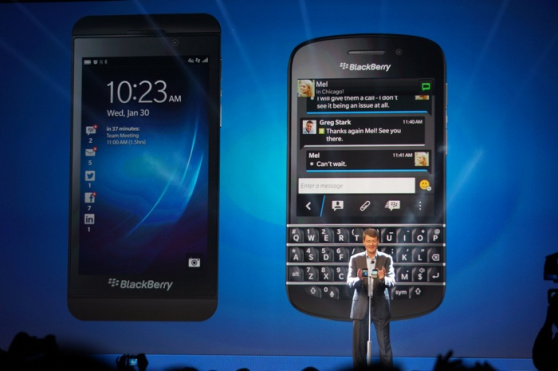
This was a particularly important period for BlackBerry because it was the first time the Z10 BlackBerry 10 phone was available for the entire quarter (the keyboard-equipped Q10 was also available for part of the quarter). The company announced that it shipped 6.8 million smartphones during Q1, 2.7 million of which were BB10 devices, and 100,000 PlayBook tablets
During the company’s earnings call this morning, CEO Thorsten Heins reiterated that he was proud of BlackBerry’s ability to offer its own mobile platform. Heins didn’t offer up any specific reasons about BlackBerry’s setbacks this quarter — he just pointed out that it’s a long and difficult process to roll out a new platform — but he expressed some hope that the BlackBerry Enterprise Server (BES) 10 rollout should help the company stay afloat.
Unfortunately for PlayBook owners, Heins confirmed this morning that it won’t be seeing a BlackBerry 10 upgrade. He cited “performance and user experience concerns” for the move — not surprising, since the tablet’s hardware is several years old by now. The BlackBerry faithful often pointed to the company’s previously announced BB10 support for the PlayBook as one of the reasons it wasn’t like Apple or Google.
Looking ahead, BlackBerry says it will focus on rolling out new BB10 phones, BES10, as well as marketing its platforms throughout the year. The company will also invest in bringing BlackBerry Messenger to other mobile platforms this summer. BlackBerry also noted that it will continue to pursue cost-saving measures — so more layoffs seem imminent.
BlackBerry’s stock is down 28 percent at the time of this post.